
Ontario is taking a major step toward the future of trucking with the launch of its Automated Commercial Motor Vehicle (ACMV) Pilot Program. This 10-year initiative allows automated heavy-duty trucks to be tested on public roads from August 1, 2025, to August 1, 2035.
What Ontario’s ACMV Pilot Program Means for Truck Drivers and the Future of Trucking
For truck drivers and fleets operating across the province, this program signals a shift toward automation, new compliance requirements, and evolving roles within the industry.
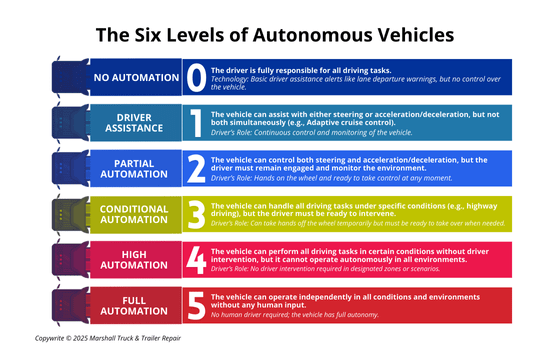
The Automated Commercial Motor Vehicle (ACMV) Pilot Program allows approved companies to test automated commercial trucks weighing over 4,500 kg equipped with advanced driving systems (Levels 3–5 automation). In a previous blog, “The Future of Trucking: Will Autonomous Vehicles Replace Jobs?”, we created a diagram that outlined the six levels of autonomous vehicles.
The goal is straightforward: they want to evaluate vehicle performance under real-world conditions, improve road safety outcomes, and assess how automation can be integrated into Ontario’s transportation system. This isn’t a full rollout of autonomous trucking; it’s a controlled, regulated testing environment designed to shape the future of the industry.
Two Key Testing Streams: Driver vs. Driverless
One of the most important aspects of the program is its two-stream structure, which reflects both current and future states of trucking.
-
-
A licensed truck driver must remain in the driver’s seat
-
The truck driver must be ready to take control at any time
-
The truck driver is still legally considered the operator, even when automation is engaged
-
-
Driverless (Remote-Supervised) Trucks:
-
No truck driver in the seat
-
A trained assistant monitors the vehicle either inside the truck or remotely within Ontario
-
Applies to higher automation levels (Level 4–5)
-
Strict Requirements for Participation
This is not an open-access program; companies must meet strict criteria to participate in the two streams listed above.
Key Requirements:
-
Submit the ACMV Application Package completed (application here)
-
Approval from Ontario’s Ministry of Transportation (MTO)
-
Demonstrated safety performance and operational experience (Electric Autonomy outlines this in more detail here)
-
Ability to prove vehicles can operate safely under Ontario conditions
Operational Rules Include:
-
Mandatory $10 million liability insurance coverage
-
Truck drivers (when present) must monitor vehicle performance at all times
-
Mandatory reporting of collisions and operational changes within 24 hours
These requirements ensure that safety remains the top priority throughout the pilot.
What This Means for Truck Drivers
Let’s address the key question: How does this impact drivers on the road today?
#1 Drivers Are Still Essential (For Now)
In most of the early testing scenarios, truck drivers are still required in the cab. Automation is being introduced as a support system, not a replacement.
#2 New Skillsets Will Be Required
Truck drivers may need to:
-
Understand automated driving systems
-
Monitor vehicle performance rather than manually control every function
-
Respond quickly when systems disengage
This represents a shift toward a “driver-technician” hybrid role.
#3 Increased Awareness on the Road
Even drivers not involved in the program should expect to encounter automated trucks. Understanding how these vehicles behave, especially in merging, braking, and lane-keeping, will become increasingly important.
Industry Impact: What’s Changing Long-Term?
The Automated Commercial Motor Vehicle (ACMV) Pilot Program is about more than testing; it’s about preparing for a fundamental shift in trucking.
-
Improved Safety Potential: Automation aims to reduce human error, fatigue-related incidents, and reaction-time delays
-
Operational Efficiency: Automated systems can optimize speed and braking, improve fuel efficiency, and reduce downtime through predictive performance
-
Infrastructure Evolution: Ontario will use insights from the program to adapt highways and logistics corridors, develop policies for wider deployment, and support integration with existing fleets
What Trucking Companies Should Be Doing Now
Even if you’re not participating in the pilot, this program is a signal to prepare.
-
Stay Informed: Regulations and program conditions may evolve over the 10 years (August 1, 2025, to August 1, 2035) as data is collected and analyzed.
-
Invest in Training: Truck drivers should begin developing familiarity with ADAS systems, telematics, diagnostics, and automation interfaces.
-
Focus on Maintenance & Compliance: Advanced trucks require advanced maintenance. Partnering with experienced service providers like Marshall Truck & Trailer Repair ensures your equipment stays compliant as technology evolves.